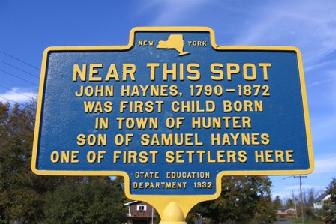
There is more than one version of the first Haines trek to the area. One goes like this: In 1779, Samuel and Elisha Haines came by foot via the Esopus Valley and through Mink Hollow into the dark and gloomy mountain tops, the trees dense and many fallen, the wolves howling, the piercing cry of the panther shrill upon the ears. At a point on Gooseberry Creek, the north branch of the Schoharie, where beavers had built a dam, they built a shelter and stored cured meat in it. The following spring, the two men returned with their wives, two horses and a cow to that same location. Two feet of snow lay upon the ground. The date of arrival was April 20, 1780. Today, the New York State Historical Marker pictured below stands next to the Village of Tannersville’s Rip Van Winkle Lake.
|
|
They belonged to a family of ten living in Southeast, lower Dutchess County, (now Putnam County) New York. Their parents were John Haines and Mary Frost, of English ancestry. Most of the land in lower Dutchess County lay within the Philipse Patent and its owners were Loyalists. When the State confiscated all Loyalist lands after the Revolution, many tenants moved rather than buying the acreage. There are a few versions of why Samuel and Elisha left Southeast.
It wasn't until 1791 that Samuel was granted the first lease of 175 acres in today's Tannersville. William*, a son of Samuel, was granted a lease in 1793; Samuel, Jr., in 1794; Edward in 1795. Between the years of 1790 and 1800, some sixty families moved to the area as a result of a promotion for settlers by the owner of Great Lot 25. Rent would be due only every seven years and 3-life leases would be given. The records show that a majority of the pioneers were from Connecticut, lower Dutchess County and Westchester County, New York.
The area now known as Haines Falls, which is less than two miles from the original Samuel Haines’ property, was first known as Haines Corners. Haines Corners and immediate vicinity was largely settled by descendants of Edward Haines.
*Some versions of the family history list William as another brother of Samuel and Elisha.
|
In 1779, long before there was a Town of Hunter or Village of Tannersville, our research indicates that the first Haines (or Haynes) family to settle on the mountaintop erected what has been referred to as a “crude habitation” near the site of the present spillway of the Village of Tannersville’s Rip Van Winkle Lake, located at the south end of Lake Street. At that time it was just a stream through a meadow, later referred to as Meadow Brook. Thus, it was a source of great pleasure and pride when the Haines Family Association re-erected this previously lost historic marker on this historically-accurate site on August 28, 2005. It was from this original location that other Haines families that followed migrated to what is now known as Haines Falls and elsewhere on the mountaintop.
|
|